


Why Your Fountain Drink Dispenser Choice Defines Your Beverage Program
A fountain drink dispenser is one of the hardest-working pieces of equipment in any restaurant, bar, or cafe. Get it right, and you have happy customers, fast service, and strong margins. Get it wrong, and you're dealing with flat drinks, downtime, and wasted syrup.
Here's a quick overview of the main fountain drink dispenser types to help you find the right fit fast:
| Dispenser Type | Best For | Key Feature |
|---|---|---|
| Countertop Tower | Self-serve stations | 1-12 valve options, high visibility |
| Drop-In Unit | Counter-integrated setups | Built-in ice chest, saves space |
| Bar Gun | High-volume bar service | Multi-flavor, handheld, space-saving |
| Draft Arm | Seltzer or single-flavor | Simple, low-maintenance |
| Ice & Beverage Combo | All-in-one efficiency | Ice + soda from one unit |
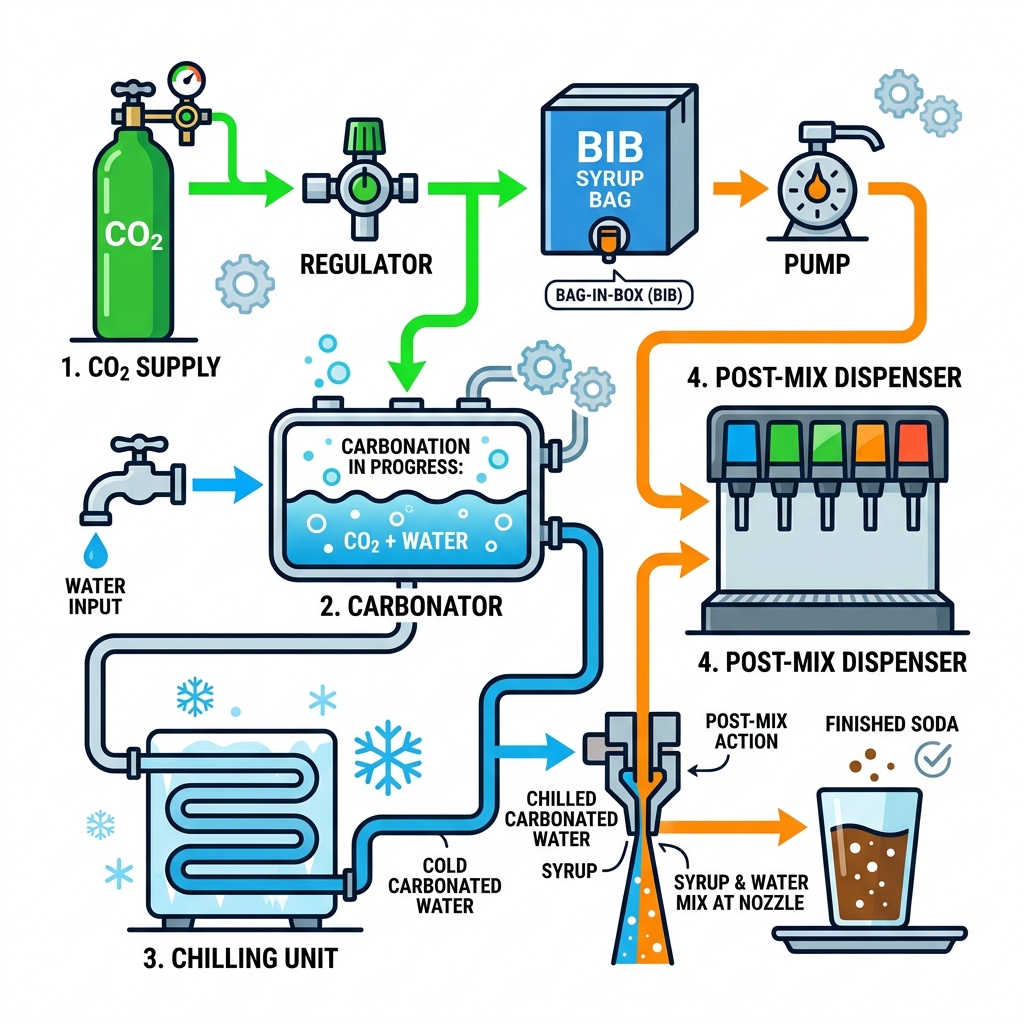
Most commercial systems are post-mix — meaning syrup and carbonated water combine at the nozzle, not before. This is the standard for restaurants because it's cost-effective, flexible, and consistent.
The difference between a great soda and a mediocre one often comes down to three things: the right equipment, a reliable syrup supply, and a consistent CO₂ source. This guide walks you through all of it — from picking the right dispenser to sourcing syrup and gas — so your beverage program runs smoothly every single day.
Whether you're setting up a new location or upgrading an aging system, understanding your options is the first step to a better pour.
Choosing the Right Fountain Drink Dispenser for Your Venue
Selecting the right fountain drink dispenser is a balancing act between available space, customer volume, and the type of service you provide. In our decades of experience serving the Philadelphia and Tri-State area, we’ve seen that the "cheapest" option often becomes the most expensive if it can't keep up with a Friday night rush.
When we talk about beverage dispensing equipment, we generally categorize units by how they are mounted and how they are cooled. For most venues in New Jersey and Delaware, a multi-flavor system is the standard, allowing you to offer everything from classic colas to craft ginger ales and sparkling waters from a single footprint.
Countertop Towers and Drop-In Units
If you walk into a quick-service restaurant or a busy cafeteria in Cherry Hill or Princeton, you’ll likely see a countertop tower or a drop-in unit. These are the workhorses of the industry.
- Countertop Towers: These sit directly on the counter. They are highly visible, which is great for branding, and can feature anywhere from one to 12 valves. They are excellent for self-service stations because they are intuitive for customers to use.
- Drop-In Units: These are integrated into the counter itself. The "guts" of the machine, including the ice chest and cold plate, are hidden below the counter level. This creates a sleek, low-profile look and is a favorite for high-end cafes or bars where counter space is at a premium.
Many of these complete soda fountain systems now feature portion control valves. This technology allows your staff to press a button for a "Small," "Medium," or "Large" drink, and the dispenser automatically stops when the cup is full. This reduces overfilling and significantly cuts down on syrup waste.
High-Efficiency Bar Guns for Fast-Paced Environments
For a bar in Atlantic City or a crowded pub in Philadelphia, a tower might take up too much room. This is where the bar gun (or soda gun) shines. These handheld dispensers are connected to a flexible, insulated manifold that can carry up to 10 or 12 different products—soda, ginger ale, tonic, juice, and plain seltzer—all in one hand.
The beauty of a bar gun lies in its efficiency. A bartender can fill a glass with ice and soda without ever turning their back on the customer. When considering beverage equipment rentals, bar guns are often the most cost-effective choice for alcohol-focused venues because they require minimal counter real estate and offer incredible speed.
Cooling and Carbonation: The Science of the Perfect Pour
We often tell our partners that a fountain drink dispenser is essentially a mini-chemistry lab. To get that "bottle-quality" crispness, the water must be carbonated at the right pressure and, most importantly, everything must be cold. Warm soda loses its carbonation almost instantly, resulting in a "flat" drink that tastes overly sweet and unappealing.
To understand the mechanics, you can look further into how beverage equipment manages these variables. The two primary methods for keeping your drinks chilled are cold plates and remote chillers.
Cold Plate vs. Remote Chiller Technology
The cooling method you choose depends on your volume and where your syrup and gas are stored.
- Cold Plate Technology: This is a passive cooling system. It consists of a heavy block of aluminum with stainless steel coils inside. The block is placed at the bottom of an ice bin. As the water and syrup travel through the coils, the surrounding ice chills the aluminum, which in turn chills the liquid. It’s reliable and requires no electricity for cooling, but it does require a constant supply of ice to remain effective.
- Remote Chillers (Power Packs): If your "back room" (where the syrup and CO2 are kept) is far from the dispenser, you need a remote chiller. This electric unit creates an "ice bank" and recirculates chilled water through an insulated bundle of lines (called a python) all the way to the dispenser. This ensures that even the first drink of the day is ice cold, regardless of the distance.
Maintaining Consistency with a Fountain Drink Dispenser
The "Golden Ratio" of the soda world is the Brix ratio. For most sodas, this is a 5:1 mixture—five parts carbonated water to one part syrup. If the ratio is off, the drink will either be "watery" or "syrupy."
Consistency also depends on:
- Water Filtration: Chlorine and minerals in local water supplies can ruin the flavor profile of your expensive syrups. High-quality filtration is a must.
- Carbonation Levels: The carbonator must be working at the correct PSI (usually around 100 PSI) to ensure the water is sufficiently "bubbly."
- Temperature Control: Ideally, the finished drink should be dispensed at 40°F or lower.
Syrup Sourcing and Gas Management Strategies
Once you have your fountain drink dispenser installed, the focus shifts to operations. This is where the "One-Stop Shop" model provides the most value. Managing multiple vendors for syrup, CO2, and equipment repair is a headache most managers don't need.
Sourcing high-quality bag-in-box syrup is the key to maintaining high margins. Whether you are looking for national brands or high-quality local alternatives that offer better value, the delivery system remains the same.
The Economics of Bag-in-box (BIB) Systems
The Bag-in-Box (BIB) system revolutionized the beverage industry. Instead of heavy glass bottles or metal kegs, syrup is stored in a heavy-duty plastic bag inside a cardboard box. A vacuum pump pulls the syrup out and sends it to the dispenser.
The math is impressive:
- A standard 5-gallon BIB mixed at a 5:1 ratio produces 30 gallons of finished soda.
- In terms of servings, that’s roughly 320 12-ounce drinks (allowing for ice).
- BIBs are easy to stack, take up minimal space, and the cardboard is fully recyclable.
For those looking to scale, wholesale syrup distribution allows you to keep costs predictable while ensuring you never run out of your most popular flavors.
Optimizing Your Fountain Drink Dispenser with Food-Grade CO2
You can have the best syrup in the world, but without CO2, you just have flat juice. Managing your gas supply is a critical part of the "Perfect Pour."
There are two main ways to handle gas:
- High-Pressure Cylinders: These are the standard green tanks you see in many bars. They are portable and great for lower-volume venues. However, they can run out at inconvenient times.
- Bulk CO2 Tanks: For high-volume locations in Wilmington or Newark, bulk CO2 tanks are the way to go. These large, stationary tanks are filled from the outside of the building by a delivery truck. You never have to swap tanks, and you never run out of gas in the middle of a rush.
If you are serving draft beer alongside your soda, you may also need gas cylinders for nitrogen or mixed gases to ensure your stouts and ales are poured with the perfect creamy head.
Installation and Maintenance for Long-Term Reliability
A fountain drink dispenser is a significant investment, and like a car, it requires regular maintenance. We’ve been "Powering the Perfect Pour Since 1955," and the biggest lesson we've learned is that preventative care is much cheaper than emergency repairs.
Professional installation services ensure that your lines are properly sized, your pressures are set correctly, and your cooling system is optimized for your specific floor plan. A poorly installed system will lead to "foaming" issues, where you're pouring more foam than soda, literally watching your profits go down the drain.
Troubleshooting and Emergency Support
Even with the best equipment, things can happen. A pump might fail, or a line might develop a leak. This is where having a local partner in the Philadelphia region becomes vital.
Common issues we help our partners solve include:
- Flat Soda: Usually a sign of an empty CO2 tank or a failed carbonator motor.
- Warm Drinks: Often caused by an "ice bridge" in the bin (where the ice isn't touching the cold plate) or a power failure to the remote chiller.
- Off-Tasting Water: A signal that it’s time to change your water filters.
Our maintenance services are designed to catch these issues before they affect your customers. Regular line cleaning is also essential to prevent "syrup mold" and ensure every drink tastes fresh.
Frequently Asked Questions
What is the standard mixing ratio for fountain soda?
The industry standard is a 5:1 ratio. This means five parts carbonated water are mixed with one part syrup. Some specialty drinks or juices may use a 4:1 or even a 3:1 ratio, but most fountain drink dispenser valves are factory-set to 5:1.
How often should soda dispenser nozzles be cleaned?
Nozzles should be removed and cleaned daily. Syrup is high in sugar, which can attract fruit flies and lead to bacterial growth if left overnight. Simply soak the nozzles in warm water and a food-safe sanitizer to keep them in top shape.
What is the difference between pre-mix and post-mix systems?
- Pre-mix: The soda is already mixed in a tank (like a giant soda bottle). It’s easy to set up but expensive to ship and store.
- Post-mix: The syrup and water are separate and mix at the dispenser nozzle. This is the commercial standard because it is much more efficient and cost-effective for high volumes.
Conclusion
At Carbonator Rental, we believe that a great beverage program is the backbone of a successful hospitality business. From the historic streets of Philadelphia to the boardwalks of Atlantic City and the busy corridors of Newark, we provide the local support that keeps your fountain drink dispenser running flawlessly.
As a family-run company with over 65 years of heritage, we don't just deliver equipment; we deliver peace of mind. Our full-service model includes:
- Dependable Delivery: We bring the syrup, the gas, and the supplies directly to your door on a schedule that works for you.
- Flexible Rental Options: We help you get the best equipment without the massive upfront capital hit.
- Local Expertise: When you call us, you’re talking to neighbors who understand your business and your community.
Whether you need a new bar gun setup or a high-capacity bulk CO2 system, we are here to help. Power your pour with Newark bar equipment rentals and experience the difference that local, professional service makes. Let us handle the bubbles so you can focus on your guests.
