

Why the Right CO2 Cylinder for Drinks Makes or Breaks Your Beverage Program
Choosing the correct CO2 cylinder for drinks is one of the most important — and most overlooked — decisions in running a bar, restaurant, or café.
Quick answer: the most common CO2 cylinders used for drinks are:
| Cylinder Type | Best For | Typical Size |
|---|---|---|
| Small aluminum cylinder | Home soda makers, portable bars | 14.5 oz – 5 lb |
| Mid-size aluminum or steel tank | Small restaurants, taprooms | 10 lb – 20 lb |
| Large aluminum or steel tank | High-volume bars, restaurants | 35 lb – 50 lb |
| Bulk CO2 system | Commercial venues, stadiums | 50 lb+ / on-site storage |
| Disposable cylinder | Home use, occasional carbonation | 560 g – 1,100 g |
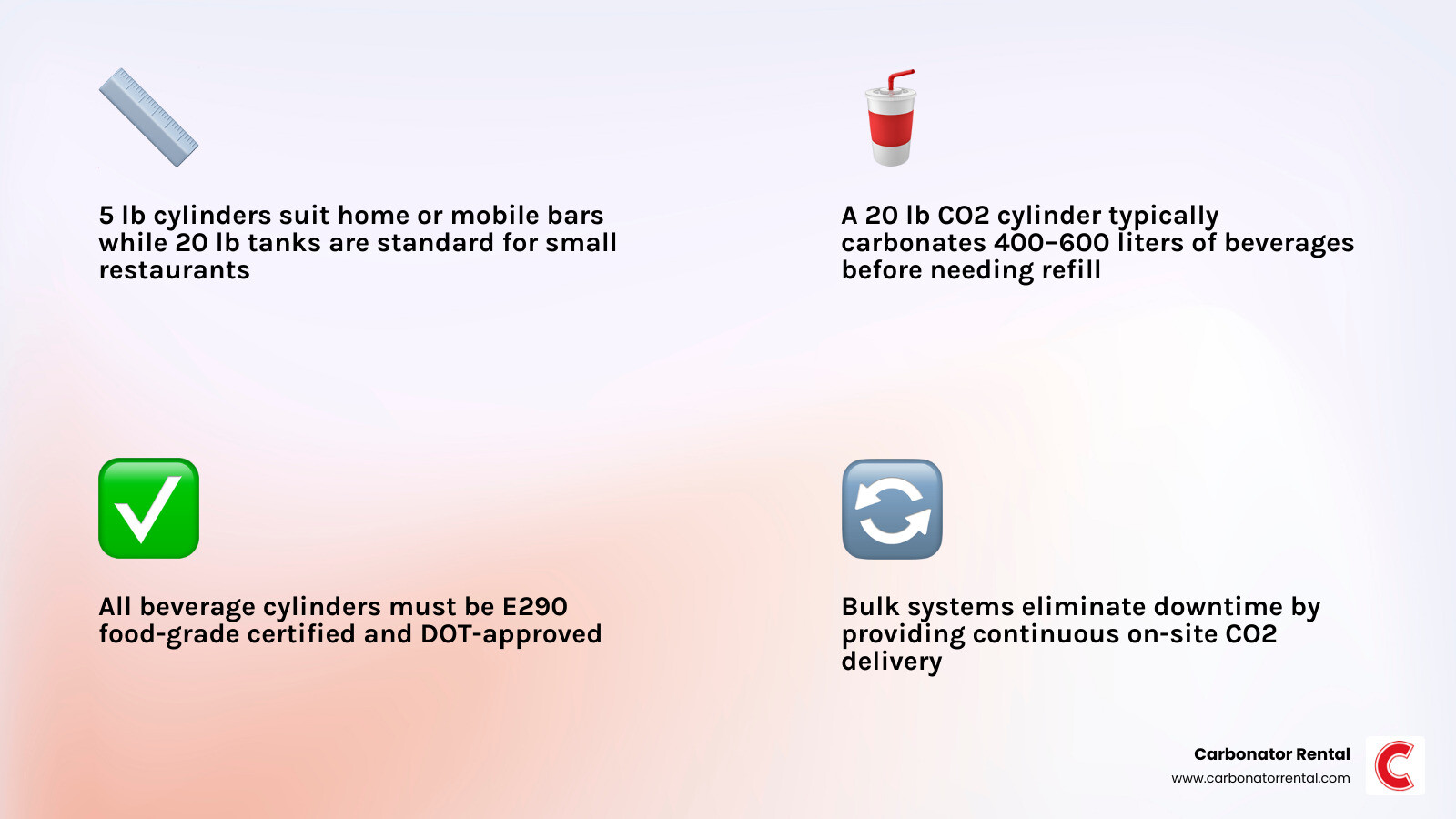
All cylinders used for beverages must be food-grade (E290 certified) and approved by the relevant regulatory body (e.g., DOT in the United States).
Without the right CO2 supply, drinks go flat, taps fail, and customers notice. Yet many operators pick a cylinder based on price alone — and end up with the wrong size, the wrong grade, or a system that can't keep up with demand.
Whether you're running a soda fountain, a draught beer system, or a home sparkling water maker, the cylinder you choose directly affects drink quality, operational uptime, and long-term cost.
This guide breaks down every key factor — from cylinder size and material to food-grade standards, refill programs, and bulk system options — so you can make a confident, informed choice.
Common co2 cylinder for drinks vocab:
- Restaurant carbonation system
- soda water co2
- water carbonation machine
Understanding the CO2 Cylinder for Drinks
The market for carbonation is divided into two primary categories: portable cylinders and stationary bulk systems. For smaller operations or specific home-use applications, lightweight aluminum cylinders are preferred due to their corrosion resistance and ease of handling. However, commercial venues typically require the durability of steel or the high capacity of aluminum alloy tanks.
In simple terms, your options usually fall into these groups:
- Refillable small cylinders for home sparkling water systems
- Refillable commercial tanks for soda fountains, kegerators, and bar systems
- Disposable cylinders for occasional or portable use
- Bulk CO2 systems for high-volume beverage service
For businesses, the goal is not just "will this make bubbles?" It is "will this keep us pouring through the lunch rush, Friday night, and the weekend game crowd?" That is a very different question.
We typically help operators think about four things first:
- Volume of drinks served
- Equipment compatibility
- Refill logistics
- Safety and compliance
If you are comparing cylinder options, our Gas Cylinders and Beverage Dispensing Equipment pages are a good starting point for commercial setups.
Selecting the Right CO2 Cylinder for Drinks by Size
Choosing the right size is critical for operational flow. A 2.5 lb or 5 lb cylinder is often sufficient for low-volume mobile bars. In contrast, most restaurants utilize 20 lb or 50 lb tanks to ensure they don’t run out during a busy weekend shift. For those moving massive volumes of soda and draught beer, a bulk system is the gold standard, providing a continuous supply without the need for manual tank swaps.
Here is a practical way to think about common sizes:
Small cylinders: 14.5 oz to 5 lb
These are best for:
- Home soda makers
- Portable beverage carts
- Small event setups
- Low-volume specialty service
A standard 60L home carbonation cylinder can carbonate up to 60 liters of sparkling water, though real-world output depends on how fizzy you like it. "Up to 60 liters" is the brochure number; "how many liters you actually get" is the thirsty-household number.
Some market pricing examples from current 2026 research:
- 60L home-use cylinders are commonly sold in multi-packs
- One major home carbonation subscription charges $16.99 per exchange cylinder
- Compatible screw-in refill cylinders are listed around EUR29.99 in some markets and also claim up to 60L output
Mid-size tanks: 10 lb to 20 lb
These are often the sweet spot for:
- Small restaurants
- Coffee shops with sparkling beverage programs
- Taprooms
- Bars with moderate soda and beer demand
A 20 lb tank is a common commercial choice because it reduces changeouts without becoming too difficult to manage.
Large tanks: 35 lb to 50 lb
These are better for:
- Busy bars
- High-volume restaurants
- Banquet facilities
- Multi-station beverage service
Research also shows 35 lb and 50 lb cylinders are commonly recommended for larger operations and events.
Bulk systems: 50 lb+ and on-site storage
These are ideal for:
- Large restaurants
- Stadium and venue beverage programs
- Facilities with multiple syrup and dispensing stations
- Operators who never want to hear, "Why is the soda flat?"
If you need help matching tank size to your setup, our Beverage Equipment team can help size the system around your actual usage instead of guesswork.
Compatibility and Connection Types
Not every CO2 cylinder fits every machine. This is where many buyers get tripped up.
Common connection formats include:
- Screw-in home carbonation cylinders
- Quick-connect home carbonation cylinders
- M11 threaded disposable cylinders
- CGA-320 valve connections for many commercial CO2 tanks in the U.S.
Home systems are especially brand- and model-specific. Some machines use classic screw-in cylinders, while newer models may use quick-connect formats. Commercial beverage systems usually use standard regulator connections, but the regulator, hose, and pressure settings still have to match the application.
For example, a disposable food-grade cylinder such as this Disposable CO2 Cylinder 640g — Food-Grade E290 | Intergases uses an M11x1 RH screw valve and is intended for compatible regulators or adapters.
A few important notes on compatibility:
- Do not force a cylinder onto a machine or regulator that does not match
- Adapters exist, but they must be rated for beverage use and installed correctly
- Third-party refill and adapter kits are available for some home carbonation machines, but they can affect warranty, safety, and compliance
- Commercial systems should always be installed with the correct regulator and line setup
In home-use markets, there are also machine-specific distinctions between screw-in and quick-connect cylinders. If someone says, "CO2 is CO2," that is only half true. The gas may be the same grade, but the valve connection definitely is not.
Food-Grade Standards and Safety Certifications
Safety is paramount when dealing with high-pressure vessels. Always look for the E290 certification, which ensures the CO2 is food-grade and free from industrial impurities like benzene or oils. Furthermore, ensure your tanks are DOT-approved and have undergone recent hydro-testing to verify structural integrity.
In a commercial environment, installing a CO2 safety monitor is no longer optional—it is a necessity. These devices detect leaks that could lead to oxygen deprivation in confined spaces like walk-in coolers, ensuring your staff and customers remain safe.
When purchasing a CO2 cylinder for drinks, we recommend checking for:
- Food-grade or beverage-grade CO2 labeling
- E290 designation for food-use CO2
- DOT approval for cylinders used in the U.S.
- Hydro-test markings showing the tank has been pressure tested on schedule
- Proper valve labeling and safe operating instructions
- A supplier that understands beverage applications, not just industrial gas in general
Food-grade matters because beverages are ingested. That sounds obvious, but it gets overlooked surprisingly often.
Our Beer Gas and beverage gas systems are designed around food-service use, where purity, pressure control, and safe handling all matter.
Why Industrial Grade Gas is Unsafe for Beverages
Industrial CO2 may be acceptable for manufacturing processes, welding, or other non-food applications, but that does not make it appropriate for drinks.
The main issue is purity and trace contaminants. Beverage systems should use food-grade CO2 because it is intended for products people consume. Research across beverage gas suppliers consistently points to beverage-grade CO2 as the correct standard for soda and beer systems.
Why this matters:
- Off-flavors can affect taste
- Impurities can create food-safety risks
- Inconsistent quality can damage beverage consistency
- Compliance issues can create liability for operators
In short: if the gas is going into a drink, it should be beverage grade. No shortcuts, no "probably fine," no mystery cylinder from a back room.
For additional commercial beverage gas context, see Tri-State Carbonation Service: Your Beverage C02 Partner .
Maximizing Efficiency with a Bulk CO2 Cylinder for Drinks System
For commercial operators, bulk CO2 is often the smartest long-term solution. A cylinder exchange model works well for smaller programs, but once beverage volume rises, swapping tanks becomes labor-intensive and risky.
A bulk system stores larger amounts of beverage-grade CO2 on-site and is typically refilled by the supplier without staff having to move heavy cylinders through the building.
That means:
- Fewer interruptions
- More consistent carbonation
- Less staff labor
- Lower chance of running empty during service
Our Bulk CO2 Tanks solutions are built for operators who need dependable flow across soda, sparkling water, and draft beverage service.
Benefits of a Bulk CO2 Cylinder for Drinks System
Switching to a bulk system eliminates the "flat drink" syndrome that occurs when a cylinder runs dry mid-service. These systems are refilled from outside the building, meaning no heavy tanks are dragged through your kitchen, and there is no risk of injury to staff during changeovers.
Additional benefits include:
- Continuous supply for high-volume operations
- Fewer emergency service calls for empty cylinders
- Reduced handling of heavy high-pressure tanks
- Better consistency for multi-station beverage systems
- Less packaging and lower waste than repeated small-cylinder turnover
- Easier forecasting and scheduled delivery planning
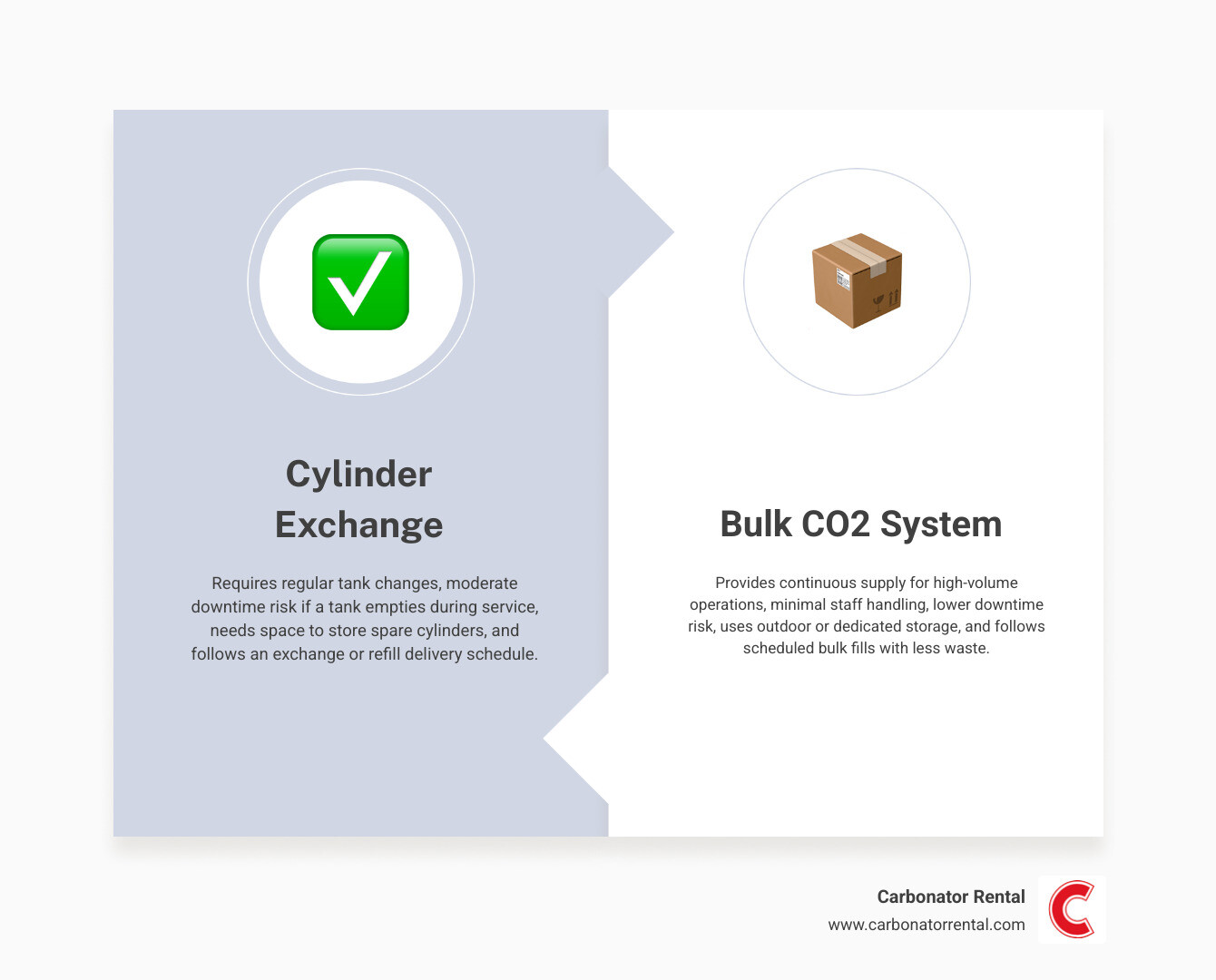
Here is a simple comparison:
| Factor | Cylinder Exchange | Bulk CO2 System |
|---|---|---|
| Best for | Small to medium demand | High-volume demand |
| Staff handling | Regular tank changes | Minimal |
| Downtime risk | Moderate if tank empties | Lower |
| Storage needs | Space for spare cylinders | Outdoor or dedicated bulk setup |
| Delivery style | Exchange/refill schedule | Scheduled bulk fill |
| Long-term efficiency | Good for smaller users | Best for heavy users |
For many bars and restaurants in Philadelphia, Newark, Atlantic City, Cherry Hill, Princeton, Wilmington, and surrounding service areas in Pennsylvania, New Jersey, and Delaware, the best system is the one that matches real demand and includes local support. That is where full-service delivery and maintenance make a real difference.
Maintenance, Refills, and Sustainability
A good carbonation program is not just about the tank. It is also about the refill plan, maintenance routine, and environmental impact of the system you choose.
Refillable cylinders usually beat disposable ones on long-term value. Disposable cylinders win on convenience for occasional use, but for regular beverage production they create more waste and usually a higher cost per use.
Research supports that pattern:
- Disposable 640 g food-grade cylinders are listed around EUR22.99 each
- A 500 g beverage cylinder is sold around $30.00 and can pressurize about 30 full kegs in a small-format system
- New refillable 5 lb aluminum cylinders are listed from about $69.95
- New 10 lb aluminum cylinders are listed from about $149.95
- Commercial suppliers commonly stock 2.5 lb, 5 lb, 10 lb, 15 lb, and 20 lb tanks
For home carbonation users, exchange and subscription programs are common. In current research:
- One major exchange program charges $16.99 per cylinder
- Spare cylinders are sold around $31.99
- Multi-pack home carbonation cylinders are sold at $59.99 for two, $87.99 for three, and $114.99 for four in one product line
Refillable vs disposable: the real-world tradeoff
Refillable cylinders
Pros:
- Lower long-term cost
- Less packaging waste
- Better for regular use
- Common in commercial systems
Cons:
- Need exchange or refill access
- Slightly higher upfront cost
- Require testing and proper handling over time
Disposable cylinders
Pros:
- Convenient for occasional use
- No exchange program needed
- Portable and simple
Cons:
- More waste
- Higher per-use cost
- Less practical for frequent carbonation
A sustainable setup usually means:
- Choosing refillable cylinders where possible
- Recycling empty approved disposable cylinders correctly
- Using a local supplier to reduce unnecessary transport
- Right-sizing the system so you are not overbuying or under-serving
How to Identify an Empty Cylinder
This is one of the most common questions, and unfortunately the answer is not always obvious until your drinks start tasting sad.
Here are the main signs:
- Carbonation drops off
- Soda pours weak or flat
- Beer loses proper push pressure
- Frost or temperature changes appear unusually around the regulator or line
- Weight is much lower than the full-tank tare-plus-fill weight
- On some systems, pressure behavior changes once liquid CO2 is nearly gone
Important detail: on CO2 cylinders, the pressure gauge can remain fairly steady for much of the tank's life because the gas is stored partly as liquid. That means gauge pressure alone is not the best "fuel gauge." Weight is usually more reliable, especially for smaller cylinders.
Best practice:
- Keep a spare cylinder for critical service
- Train staff to recognize flat-drink warning signs
- Track average replacement intervals
- For commercial venues, consider a bulk system or scheduled exchange plan
Frequently Asked Questions about Beverage Carbonation
What is the difference between E290 and standard CO2?
E290 is the food-grade designation commonly used for carbon dioxide intended for food and beverage use. In practical terms, if you are carbonating drinks, you want beverage-grade CO2 that meets food-use purity standards. "Standard CO2" is too vague. For drinks, always look for food-grade labeling.
How many liters can a standard 60L cylinder carbonate?
A standard 60L home carbonation cylinder is typically marketed to carbonate up to 60 liters of sparkling water. Actual output varies based on:
- Desired fizz level
- Water temperature
- Machine efficiency
- Whether the user is making lightly sparkling or aggressively fizzy water
So yes, "up to 60 liters" is realistic as a max estimate, but real household results may be lower.
Are aluminum tanks better than steel for beverage use?
Not always better, but often better for specific applications.
Aluminum tank advantages:
- Lighter to handle
- Corrosion resistant
- Popular for homebrew and portable use
Steel tank advantages:
- Durable
- Often preferred in fixed commercial settings
- Available in many larger-capacity options
For many beverage businesses, the best choice depends more on application, handling, and refill logistics than on one material being universally superior.
Conclusion
The right CO2 cylinder for drinks depends on more than just tank size. You need the correct gas grade, the right connection, a sensible refill plan, and a setup that matches your actual beverage volume.
For a home user, that may mean a 60L refillable cylinder or a small disposable backup. For a restaurant, bar, café, brewery, or event venue, it often means stepping up to commercial tanks or a bulk system that prevents downtime and protects drink quality.
That is exactly where we come in.
Since 1955, we have helped beverage operators stay ready with food-grade gas, dependable equipment, and local support. We supply commercial beverage equipment, installation, maintenance, scheduled delivery, and fast service across Philadelphia, Newark, Atlantic City, Cherry Hill, Princeton, Wilmington, and surrounding areas in Pennsylvania, New Jersey, and Delaware.
If you are planning a new beverage setup or upgrading an existing one, explore:
- Bulk CO2 Tanks
- Gas Cylinders
- Beverage Equipment
- Beverage Dispensing Equipment
- Beer Gas
- https://www.carbonatorrental.com/
We power the perfect pour with full-service support, flexible rental options, and local delivery that helps keep your drinks flowing and your staff focused on service instead of swapping tanks at the worst possible moment.
