

Why the Bag-in-Box Syrup Expiration Date Matters for Your Beverage Operation
The bag-in-box syrup expiration date is one of the most important — and most overlooked — details in running a smooth beverage operation.
Quick answer: How long does bag-in-box syrup last?
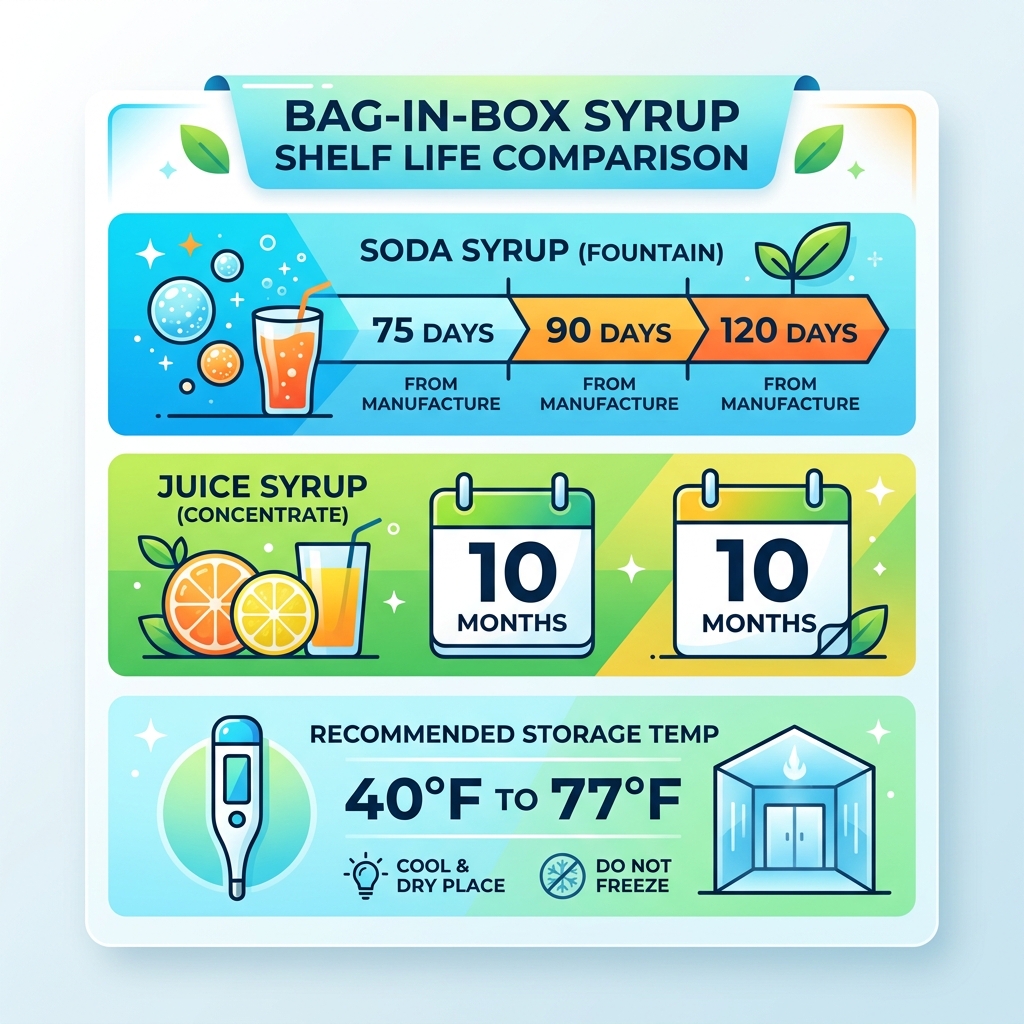
| Syrup Type | Shelf Life (Unopened) |
|---|---|
| Coca-Cola / fountain soda syrups | 75, 90, or 120 days from manufacture |
| Mello Yello and similar products | 75 days from manufacture |
| Juice concentrate syrups (e.g., Swanel) | Up to 10 months |
A few key facts to know right away:
- Enjoy-By dates are stamped on the box label — not the bag itself
- Soda syrups must be delivered no later than 30 days before the Enjoy-By date
- Age does not affect the safety of fountain syrup if the container is intact — but it can affect taste and color
- Proper storage temperature is 40°F to 77°F — no exceptions for most syrups
For a restaurant or bar, a missed expiration date doesn't just waste money. It can mean flat, off-tasting drinks — and disappointed customers who don't come back.
Coca-Cola European Partners made headlines during the COVID-19 lockdowns when they began refrigerating their bag-in-box stock to extend shelf life — and then relabeling boxes with updated dates. At least one publican contacted trade press in frustration, not understanding why the dates had changed. CCEP confirmed the quality was unaffected, but the episode shows just how much confusion surrounds BIB syrup dating.
Understanding how expiration dates work — and how to manage them — is essential for anyone running a high-volume beverage program.
Understanding the Bag-in-Box Syrup Expiration Date
When we talk about the bag-in-box syrup expiration date, we are usually looking at a "Best-By" or "Enjoy-By" date. Unlike milk or meat, where an expiration date is a hard line for food safety, syrup dating is primarily about quality.
In the beverage industry, manufacturers set these dates to guarantee that the flavor profile, carbonation interaction, and color of the syrup remain exactly as intended. Once you pass that date, the high sugar content or artificial sweeteners may begin to degrade.
Decoding the Bag-in-Box Syrup Expiration Date on Labels
If you look at a standard BIB (Bag-in-Box), you won't just see a simple date. You’ll see a string of numbers and letters that can look like a secret code. These labels typically include:
- SAP Material Number: This identifies the specific product type.
- Resource Number: This tells the manufacturer which facility produced the syrup.
- SAP Batch Number: This is the specific "lot" or "batch" the syrup came from.
- The Enjoy-By Date: This is the most critical piece of info for your staff.
For example, on a Coca-Cola BIB, the label might explicitly state "75 Days" followed by the date. In Canada, you might see a day code where "E" represents Friday, alongside the production time. Understanding these codes is the first step in maintaining a high standard of quality. For more technical details on reading these codes, you can refer to the official Syrup Quality Guidelines.
Standard Shelf Life for Soda and Juice Syrups
Not all syrups are created equal. The standard shelf life varies significantly depending on the ingredients.
- Fountain Soda Syrups: Most major brands have a shelf life of 75, 90, or 120 days. Diet sodas are on the shorter end of that spectrum because artificial sweeteners like aspartame are more sensitive to time and temperature than high-fructose corn syrup.
- Juice Concentrates: Brands like Swanel offer juice bag-in-box syrups that can last up to 10 months. This is a massive advantage for bars in Philadelphia or Newark that want to reduce waste compared to buying bottled juices that spoil in a matter of days.
At Carbonator Rental, we specialize in wholesale bag-in-box syrup distribution, ensuring that our clients in the Delaware Valley receive fresh stock with plenty of time remaining on the "Enjoy-By" clock. We follow a strict 30-day delivery rule: you should never receive a syrup that is within 30 days of its expiration.
Factors Influencing Syrup Shelf Life and Quality
Why does one box of syrup taste great after three months while another tastes "off"? It usually comes down to environmental factors. Syrup is a shelf-stable product, but it isn't invincible.
Temperature and Environmental Controls
The "Goldilocks" zone for syrup storage is 40°F to 77°F (4.4°C to 25°C).
- Heat is the Enemy: If you store your BIBs in a hot kitchen or near a boiler in Atlantic City, the heat will accelerate the breakdown of chemical bonds in the syrup. This results in a "burnt" or metallic taste.
- Freezing is a Risk: Freezing can cause the syrup to separate or even damage the bag's integrity. While some syrups (like fruit breakfast syrups) can be frozen, fountain syrups should generally be kept at room temperature.
- Diet Syrup Sensitivity: Aspartame, the sweetener in most diet sodas, is notoriously fragile. High temperatures will destroy the sweetness, leaving the drink tasting bitter or flat.
Is it Safe to Use After the Bag-in-Box Syrup Expiration Date?
This is the question we get most often at Carbonator Rental. The short answer is: Yes, it is generally safe, but it won't taste good.
As long as the bag remains vacuum-sealed and no impurities have entered the system, the high sugar content acts as a natural preservative that inhibits bacterial growth. However, the quality will fall off a cliff. The color may darken, and the flavor will lose its "punch." For a detailed look at how opening a container changes things, check out this guide on Does Syrup Expire If Opened?.
If you are serving customers in a high-end Princeton restaurant or a busy Wilmington bar, using expired bag-in-box syrup is a risk to your reputation.
Proper Storage and Handling to Maximize Freshness
Proper handling starts the moment the delivery truck arrives. We always tell our clients: "Treat your syrup like your beer—keep it organized and keep it clean."
Inventory Management and Rotation
We advocate for the FEFO principle: First to Enjoy-By, First-Out. Don't just stack new boxes on top of the old ones. When a new shipment arrives, move the older boxes to the front.
Stacking and Storage Rules:
- Stacking Limits: Never stack 5-gallon BIBs more than 5 high. For 2.5-gallon boxes, the limit is 10 high. Stacking them too high can crush the boxes at the bottom, leading to leaks.
- Floor Clearance: Store all BIBs at least 6 inches (15 cm) off the floor. This prevents damage from floor cleaning chemicals and keeps the product away from potential pests.
- Level Playing Field: If you have multiple BIBs connected to the same line (using a selector valve), make sure they are all on the same level. This ensures even pressure and prevents one bag from being sucked dry before the other.
Sanitization During Bag Changes
Contamination usually happens at the point of connection. Every time you change a bag, you have an opportunity to introduce bacteria into your soda system.
Our Recommended Bag-Change Procedure:
- Wash Your Hands: Simple, but often forgotten in a busy kitchen.
- Disconnect: Unscrew the connector from the empty bag.
- Sanitize: Soak the connector in a chlorine-based sanitizer solution for at least one minute.
- Open the New Box: Use your palm to hit the flap sharply. Never use a knife or sharp instrument, as you might puncture the bag inside.
- Connect: Remove the dust cap from the new bag, pull the connector through, and tighten it until it is fully engaged.
- Flush: Operate the dispensing valve (the soda gun or fountain lever) for a few seconds to ensure the new syrup is flowing through the lines.
How to Identify Spoiled Bag-in-Box Syrup
Sometimes, despite your best efforts, a box goes bad. Here is how to spot it before a customer does.
Signs of Spoilage in Fountain Drinks
- Off-Flavors: If the drink tastes fermented, vinegary, or unusually sour, the syrup has likely been contaminated by yeast or mold.
- Texture Changes: If the syrup looks "stringy" or has visible clumps, discard it immediately. This is a sign of microbial growth.
- Color Fading: While common in older syrups, a significant change in color (like a cola looking light brown or a lemon-lime soda looking yellow) indicates oxidation.
- Crystallization: Sometimes sugar crystals form at the bottom. While not necessarily "spoiled," it can clog your lines and bar guns.
The Role of Refrigeration in Extending Life
Normally, you should not refrigerate BIB syrup. It makes the syrup too thick to pump properly. However, there are exceptions.
During the 2020 lockdowns, many beverage companies refrigerated their stock to "pause" the clock on expiration. By keeping the syrup at a constant low temperature, they were able to extend the shelf life by several months without impacting quality. When the hospitality industry reopened in places like Philadelphia and Newark, these boxes were relabeled with new "Enjoy-By" dates.
If you ever find yourself with a surplus of stock due to a temporary closure, refrigeration is a viable way to protect your investment—just make sure the syrup returns to room temperature before you try to hook it up to your system!
Frequently Asked Questions about BIB Syrup Expiration
Does BIB syrup need to be refrigerated?
No. Under normal operating conditions, BIB syrup should be stored at room temperature (40°F to 77°F). Refrigeration is only used as an emergency measure by manufacturers to extend shelf life during extreme supply chain disruptions.
Can I use syrup if the box is damaged?
If the outer cardboard box is damp or crushed but the inner plastic bag is intact and hasn't lost its vacuum seal, the syrup is likely fine. However, if the bag is punctured, discard it. Once air enters the bag, the bag-in-box syrup expiration date becomes irrelevant—the product will spoil rapidly.
How many drinks does one gallon of syrup yield?
Standard soda syrup is mixed at a 5-to-1 ratio (five parts carbonated water to one part syrup). One gallon of syrup yields approximately 768 fluid ounces of finished beverage. That’s about 64 twelve-ounce drinks!
Conclusion
Managing your bag-in-box syrup expiration date is a small task that pays huge dividends in beverage quality and cost savings. By following the FEFO rotation method, keeping your storage area between 40°F and 77°F, and maintaining strict sanitization habits, you ensure that every pour is perfect.
At Carbonator Rental, we’ve been Powering the Perfect Pour Since 1955. We don’t just deliver syrup; we provide the local support, equipment maintenance, and emergency service that bars and restaurants in Philadelphia, New Jersey, and Delaware need to thrive. Whether you need a new soda gun installation in Cherry Hill or a CO2 refill in Wilmington, we are here to help.
Ready to upgrade your beverage program? Learn more about our bag-in-box syrup options and how we can support your business today.
