

Why Equipment Service Contracts Matter for Your Business

Equipment service contracts are paid agreements that provide scheduled maintenance, repairs, and parts replacement for your commercial beverage equipment—like soda fountains, bar guns, and CO₂ systems—to prevent breakdowns and keep your operation running smoothly.
Quick Answer: What You Need to Know
- What they are: Separate agreements (not warranties) that cover labor, parts, and service for a fixed fee
- Core types: Preventative (scheduled), corrective (reactive), comprehensive (all-inclusive), and annual plans
- Key benefits: Reduced downtime, predictable budgets, extended equipment life, priority support
- Average cost of downtime: $260 per hour, with businesses losing 800+ hours annually
- Price trends: Service contracts increase 10-12% each year from manufacturers
- When worth it: High-use equipment, critical operations, aging assets beyond warranty
You've invested in quality beverage equipment that keeps your bar, restaurant, or cafe running. A soda fountain goes down on Friday night. Your CO₂ system fails during lunch rush. Your bar gun starts leaking mid-shift.
Without a service agreement, each emergency means scrambling for a technician, waiting days for parts, and watching revenue disappear while equipment sits idle. Research shows businesses experience over 800 hours of equipment downtime per year—that's more than 15 hours every week.
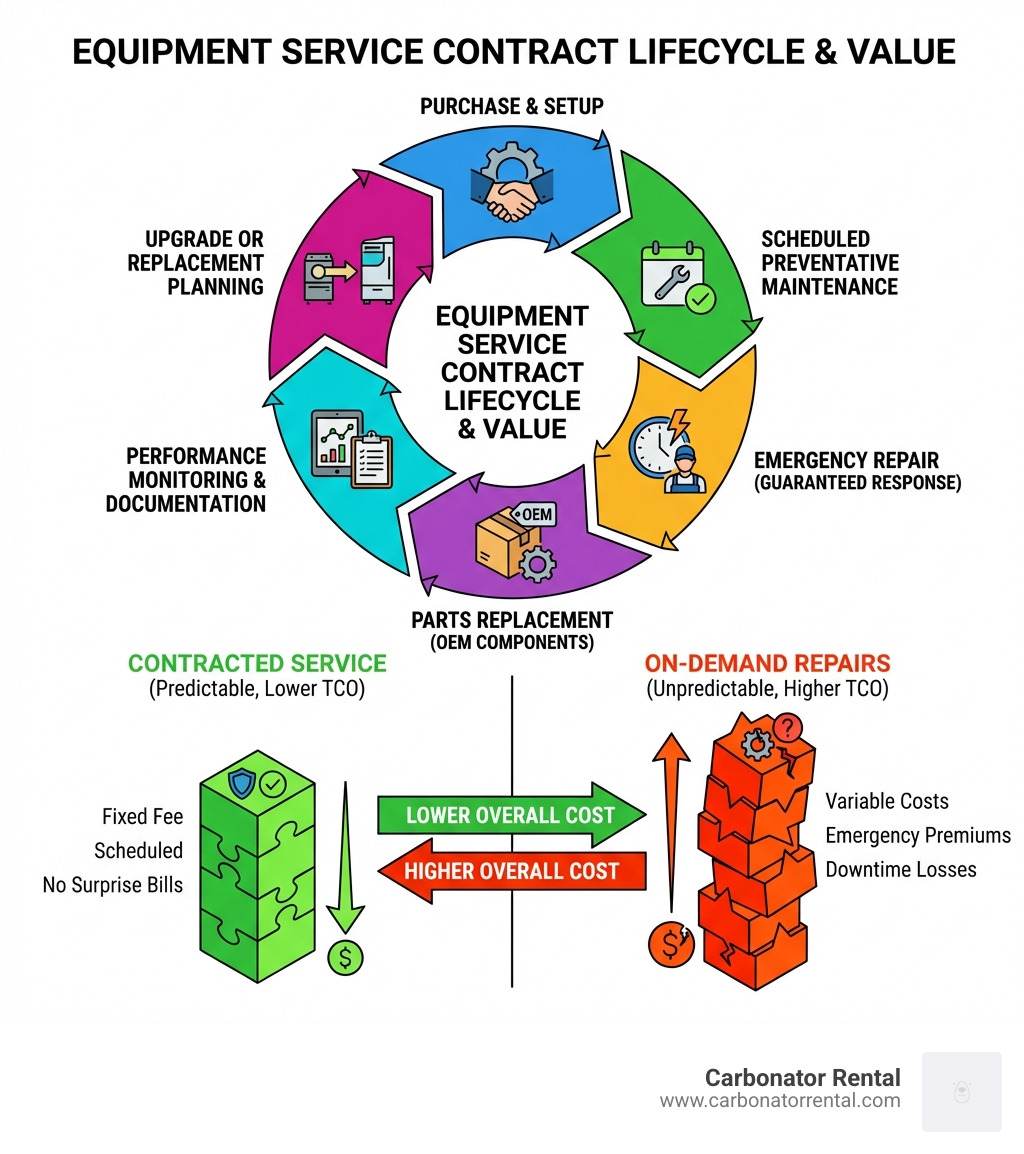
Service contracts shift this equation. They're not warranties—they're proactive partnerships that schedule maintenance before problems start, guarantee response times when issues arise, and lock in fixed costs while protecting against repair inflation and surprise bills.
This guide breaks down everything you need to know: the different contract types, what coverage actually costs versus saves, how to avoid common pitfalls, and when service agreements make financial sense for commercial beverage operations.
Understanding Equipment Service Contracts and Maintenance Agreements

At its core, an equipment service contract is a legal agreement between you and a service provider that outlines the terms and conditions for the upkeep of your machinery. Whether you are running a high-volume bar in Philadelphia or a quiet cafe in Wilmington, these agreements act as an insurance policy for your productivity.
The primary goal is to establish a Service Level Agreement (SLA) that guarantees a certain standard of performance. This includes "uptime guarantees"—promises that your equipment will be functional for a specific percentage of time—and defined response times. When a carbonator fails, you don't want to hear "we'll get there when we can." You want a contract that says "we'll be there within four hours."
This is critical because each hour of unplanned downtime costs $260 on average. For a restaurant, that cost can be even higher if it means you can't serve drinks during a peak Saturday night rush.
Defining the Equipment Service Contracts
These contracts are more than just a "fix-it" promise. They are a tool for asset management. By defining performance standards and contractual terms, you ensure that the service provider is held accountable. For us at Carbonator Rental, this means providing local support across New Jersey, Delaware, and Pennsylvania to ensure your soda guns and nitrogen generators never skip a beat.
Key Elements of a Successful Agreement
A well-drafted contract should never be vague. It needs to include:
- Detailed Equipment Inventory: A list of every serial number and model covered (soda fountains, CO2 tanks, etc.).
- Scope of Work: Exactly what tasks are performed during a visit (e.g., cleaning lines, checking pressures).
- Payment Terms: Whether it is a fixed annual fee or a monthly installment.
- Emergency Protocols: How to report a failure after hours and what the guaranteed response window is.
- Termination Clauses: Clear rules on how to end the partnership if service standards aren't met.
The Core Types of Equipment Service Contracts
Not all equipment service contracts are created equal. Depending on your budget and the age of your gear, you might choose a basic "check-up" plan or a "white-glove" comprehensive package.
Preventative vs. Corrective Equipment Service Contracts
The most common debate is between preventative and corrective service.
- Preventative Maintenance (PM): This is proactive. It involves scheduled inspections and routine cleaning to catch small issues before they become disasters. Predictive maintenance has the potential to extend asset life by up to 40%. Think of it like changing the oil in your car; if you skip it, you’ll eventually be replacing the whole engine.
- Corrective Maintenance: This is reactive. It covers the "oops, it broke" moments. While necessary, relying solely on corrective maintenance is risky because it doesn't prevent the initial failure.
Comprehensive and Annual Maintenance Plans
For businesses that can't afford a single minute of downtime, a Comprehensive Maintenance Contract (CMC) is the gold standard. These usually feature:
- Fixed Annual Fees: No surprise bills for parts or labor.
- 24/7 Support: Coverage for those late-night bar emergencies.
- OEM Parts: Ensuring only genuine factory parts are used, which improves durability.
- Priority Dispatch: You move to the front of the line when things go wrong.
Why Service Coverage is a Critical Business Investment
Investing in a service contract isn't just an expense; it’s a strategy for long-term cost savings. Beyond just fixing broken parts, these agreements improve energy efficiency. For example, an HVAC or cooling system that isn't maintained can use 20% more energy, driving up your utility bills.
Reducing Downtime and Maximizing Lifespan
With businesses experiencing 800+ hours of downtime per year, the goal is workflow continuity. Regular maintenance ensures your assets don't depreciate faster than they should. In the beverage industry, neglected lines can lead to poor-tasting soda, which drives away customers. Proper care ensures your bag-in-box syrup tastes exactly as it should, every time.
Financial Predictability in High-Stakes Environments
We live in an era of "repair inflation." Manufacturers typically increase service contract prices by 10-12% each year. By locking in an agreement now, you protect your operational budget from these spikes. Furthermore, replacing a single major component, like a PCB in a high-end dispenser, can cost 20% of the original equipment price. A service contract absorbs that shock.
| Feature | On-Demand Repairs | Service Contract |
|---|---|---|
| Cost | Variable & High | Fixed & Predictable |
| Response Time | Best Effort | Guaranteed (SLA) |
| Maintenance | None (Reactive) | Scheduled (Proactive) |
| Parts | Full Price | Usually Included |
| Lifespan | Shorter | Up to 40% Longer |
Navigating Tax Rules and Managed Equipment Services (MES)
Understanding the financial side of service agreements also means looking at taxes and modern procurement models. While specific rules like British Columbia's PST might not apply to our partners in Newark or Atlantic City, the general principle of "Mandatory vs. Optional" contracts usually dictates how sales tax is applied across Pennsylvania, New Jersey, and Delaware.
Tax Implications for Service Agreements
In many jurisdictions, if a service contract is mandatory (bundled with the purchase), it is taxed as part of the total sale. If it is optional, it may be treated differently. Always ensure your documentation clearly separates labor from parts if your local state tax code requires it. For businesses using production machinery or specific farming equipment, there may even be exemptions available.
The Rise of Managed Equipment Services (MES)
MES is a newer model where you essentially outsource the entire lifecycle of your equipment. Instead of owning the gear and buying a separate service plan, you enter a long-term partnership where the provider handles procurement, installation, maintenance, and eventual replacement.
- Capital Savings: MES can contribute to capital savings of up to 10%.
- Technology Banding: This ensures your equipment is always "state-of-the-art." When a dispenser becomes obsolete, the MES provider replaces it as part of the agreement.
Best Practices for Managing Your Service Portfolio
Managing your equipment service contracts shouldn't be a full-time job. With the right approach, it becomes a seamless part of your operation.
Avoiding Common Pitfalls in Drafting
When reviewing an agreement, keep an eye out for:
- Hidden Costs: Does the contract cover travel fees? Some providers charge "no-charge travel" only within a certain radius (like 100km).
- Vague Scope: Does "maintenance" include deep cleaning or just a visual inspection?
- Exclusion Clauses: Are "consumables" like gaskets or O-rings excluded?
- Renewal Terms: Watch for "evergreen" clauses that renew the contract automatically at a higher rate.
Leveraging Software for Simplified Management
Modern service providers use software to reduce administrative burdens. Digital service tickets and automated scheduling mean you don't have to remember when your next filter change is due—the system does it for you. This level of organization is how we ensure our bag-in-box syrup customers in places like Princeton and Cherry Hill always have the CO2 and functional equipment they need for the perfect pour.
Frequently Asked Questions about Equipment Service Contracts
Is a service contract worth the investment compared to on-demand repairs?
Absolutely. While on-demand repairs might seem cheaper when things are running well, a single emergency repair with overtime labor and expedited parts shipping can cost more than an entire year of service coverage. Plus, you can't put a price on the peace of mind that comes with priority support.
What is the difference between a manufacturer warranty and a service agreement?
A manufacturer warranty usually covers factory defects for a limited time (often 1 year). It rarely covers routine maintenance or "wear and tear." A service agreement begins where the warranty ends, covering the ongoing maintenance and accidental issues that a standard warranty ignores.
Can I cancel or transfer my service contract if I sell my business?
Most professional contracts are transferable to a new owner, which can actually increase the resale value of your business. Cancellation policies vary, but many allow you to cancel within 30-60 days for a full or pro-rated refund.
Conclusion
Managing a bar or restaurant is hard enough without worrying about equipment failure. By choosing the right equipment service contracts, you're not just buying repairs; you're buying reliability, efficiency, and a longer life for your gear.
At Carbonator Rental, we’ve been "Powering the Perfect Pour Since 1955." From Philadelphia to Newark and Wilmington, we provide the full-service support, local delivery, and high-quality bag-in-box syrup that keeps your business bubbling. Don't wait for a breakdown to realize the value of a maintenance plan—protect your investment today and keep the drinks flowing.
