


Why Beer Gas Blenders Are Essential for a Perfect Draft Pour
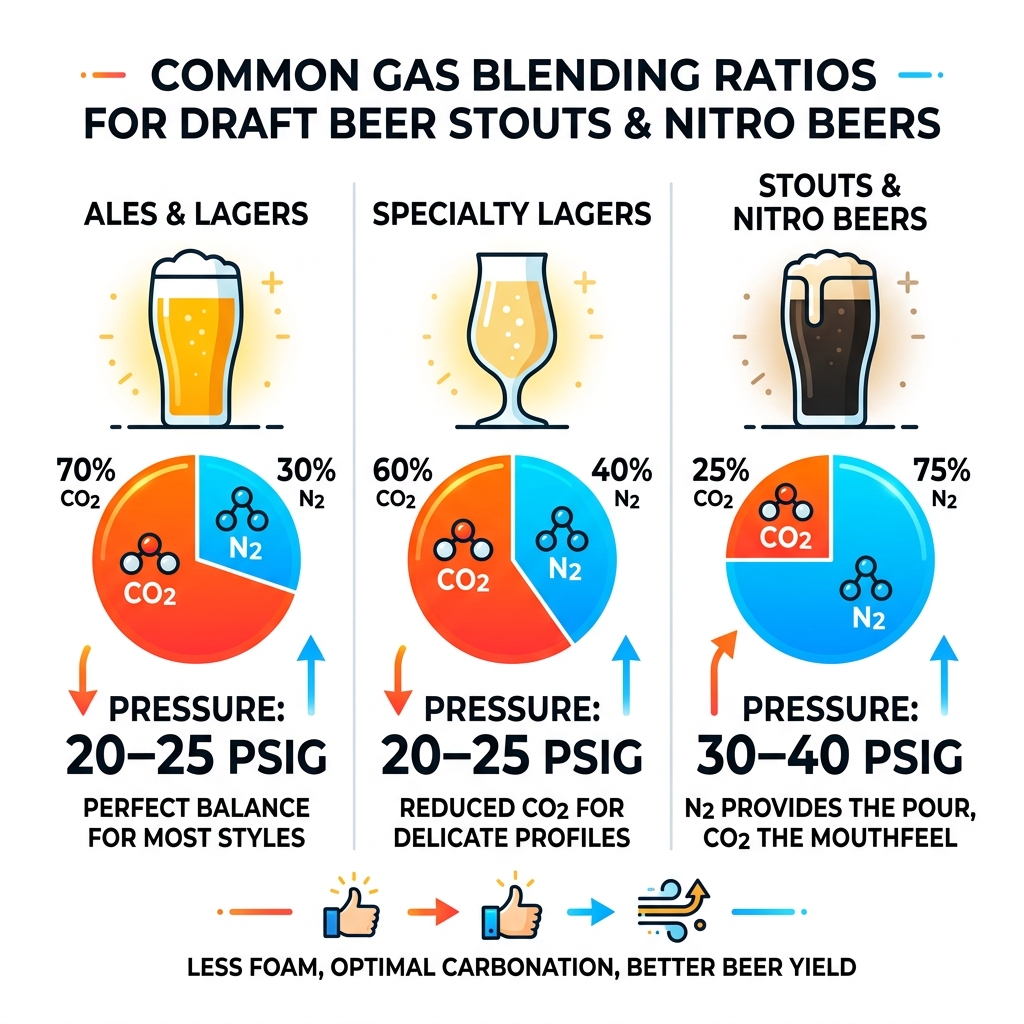
Beer gas blenders are devices that mix pure CO2 and nitrogen (N2) on-site to create the exact gas ratio your draft system needs. Here's a quick look at the most common blends:
| Beer Style | CO2 | N2 | Typical Pressure |
|---|---|---|---|
| Ales & Lagers | 70% | 30% | 20–25 PSIG |
| Specialty Lagers | 60% | 40% | 20–25 PSIG |
| Stouts & Nitro Beers | 25% | 75% | 30–40 PSIG |
Getting the blend wrong is costly. Up to 20% of beer can turn to foam and go unsold when the gas ratio is off. On the flip side, too little carbonation leads to flat beer and over-pouring — roughly 20% more beer per pint, quietly eating into your margins.
The good news? A quality gas blender solves both problems at once.
Bar and restaurant owners who switch to proper on-site gas blending regularly see an 8–20% increase in draft beer yield. Some venues report a 30% jump in beer sales simply because every pint looked and tasted the way it was supposed to.
In this guide, we'll walk you through how beer gas blenders work, the right ratios for every beer style, how to choose and install one, and how to maximize your return on the investment.
How Beer Gas Blenders Work
At its core, a beer gas blender is a precision instrument designed to solve a fundamental physics problem in your bar: partial pressure. When you hook up a keg, the gas in the headspace must stay in equilibrium with the gas dissolved in the liquid. If you use 100% CO2 in a long-draw system (where the keg is far from the tap), you have to crank up the pressure to push the beer through the lines. This extra pressure forces more CO2 into the beer, creating "beer mousse"—that thick, over-carbonated foam that bartenders end up pouring down the drain.
A gas blending panel takes pure CO2 and pure Nitrogen from separate gas cylinders or generators and mixes them on-demand. Nitrogen acts as the "brawn," providing the mechanical push needed to get the beer to the faucet without being absorbed into the liquid. Meanwhile, the CO2 provides the "fizz" and flavor.
By maintaining this balance, the blender ensures that the gas pushing the beer exactly matches the carbonation level the brewer intended. These systems are typically mechanical, requiring no electricity, and operate with a flow capacity that can support anywhere from 10 to 26 kegs per hour depending on the inlet pressure.
Benefits of Beer Gas Blenders
The most immediate benefit we see at Carbonator Rental is a massive yield increase. When your gas is balanced, you stop "pouring money down the drain." Research shows that establishments can realize an 8-20% increase in draft beer yield simply by eliminating over-foaming.
Beyond the bottom line, there is the matter of flavor preservation. Using the wrong gas blend can strip a beer of its character or make it taste "sharp" and over-carbonated. By using the right beverage dispensing equipment, you ensure that every pint tastes brewery-fresh from the first pour to the last drop in the keg. For more technical details on the gases themselves, you can explore our page on Beer Gas.
Optimal Ratios for Different Beer Styles
Not all beers are created equal, and their gas requirements reflect that. To help our partners in Philadelphia and New Jersey achieve the perfect pour, we focus on three primary ratios:
- 70/30 Ratio (70% CO2 / 30% N2): This is the "gold standard" for most ales and lagers. It provides the ideal equilibrium for standard carbonation levels (2.2 to 2.8 volumes of CO2) in systems with longer lines.
- 60/40 Ratio (60% CO2 / 40% N2): Often used for specialty lagers or European imports that require a slightly different pressure profile to maintain their crisp finish.
- 25/75 Ratio (25% CO2 / 75% N2): This is the "Nitro" blend. If you are serving a stout like Guinness or a nitrogenated craft ale, you need this high-nitrogen mix to create that iconic cascading effect and creamy, thick head.
If you aren't sure which blend your specific system needs, you can use professional calculators for gas blends to determine the exact requirements based on your beer temperature and line length.
Maintaining Your Beer Gas Blenders
To keep your system running accurately, you must monitor your pressure settings and temperature. Most blenders are factory-preset, but they require consistent inlet pressure (usually about 10-20 PSI higher than the desired outlet pressure) to function correctly.
We recommend keeping your keg storage area between 34°F and 38°F. Temperature fluctuations are the enemy of carbonation stability. Additionally, be aware that many blending components are made of brass; you may see a P65 Warning for brass components regarding trace amounts of lead. We ensure all our installations meet safety standards and perform regular accuracy testing—standard blenders should maintain an accuracy of +/- 2% to ensure your beer stays perfect.
Maximizing Profit with On-Site Blending
The math behind switching from pre-mixed cylinders to on-site blending is staggering. Pre-mixed "beer gas" cylinders are often inconsistent and significantly more expensive per cubic foot of gas.
| Feature | Pre-Mixed Cylinders | On-Site Blending |
|---|---|---|
| Accuracy | Varies (often +/- 5-10%) | Guaranteed +/- 2% |
| Waste | High (due to imbalance) | Minimal (8-20% yield increase) |
| Cost | Higher per unit | Lower (uses pure CO2/N2) |
| Labor | Frequent tank swaps | Automatic mixing |
In one real-world example, a busy college bar saved over $2,000 per month in wasted beer by switching to a blender. Another venue saw a 30% increase in sales because the improved pour quality kept customers coming back for another round. When you invest in the right beverage equipment, the system often pays for itself in just a few months through foam reduction alone.
Selecting Your Beer Gas Blenders
When choosing a blender for your establishment in the Delaware Valley, you need to consider your tap list. We offer several configurations:
- Single Blend: Perfect for bars that only serve one type of beer (e.g., all lagers). These are often preset to 70/30 or 60/40.
- Double Blend: The most popular choice for modern craft beer bars. It allows you to run one line for lagers (70/30) and a second line for nitro stouts (25/75).
- Triple Blend: For high-volume venues with diverse offerings, including high-carbonation imports and nitro beers.
Modern units like the Trumix series can support up to 26 kegs per hour at 110 PSI inlet pressure. These units feature a tamper-proof design and are factory-calibrated, so you don't have to worry about staff accidentally changing the ratios.
Installation and Safety Requirements
Installing beer gas blenders requires precision. They should be wall-mounted in a clean, accessible area. You will need primary regulators with high-pressure blow-offs (115-125 psi) and high-pressure braided tubing to connect the gas sources.
Safety is paramount. We highly recommend integrating leak detectors like the BlastOff technology. These systems monitor for gas leaks and will automatically shut down the system if a leak is detected, preventing the loss of expensive gas and protecting your staff from CO2 buildup. Many of our systems also integrate with nitrogen generators, which extract N2 directly from the air, eliminating the need for heavy nitrogen tank deliveries and ensuring you never run out of gas during a Saturday night rush.
Frequently Asked Questions about Gas Blending
What is the best gas blend for a nitro stout?
The industry standard for nitro stouts is 25% CO2 and 75% Nitrogen. This ratio, when pushed at 30-40 PSIG through a restrictor plate faucet, creates the creamy mouthfeel and beautiful cascade that customers expect from a stout.
Can I use a gas blender with a nitrogen generator?
Yes! In fact, this is the most efficient setup. The nitrogen generator provides a continuous supply of high-purity N2, and the blender mixes it with your bulk CO2. This setup is safer, more reliable, and more cost-effective than using cylinders.
How does temperature affect my gas blend ratio?
Temperature is a critical variable. As beer gets warmer, it releases CO2 more easily, requiring higher pressure to stay carbonated. If your walk-in cooler temperature fluctuates, your "perfect" gas blend might start causing foam. We recommend keeping your system at a steady 38°F for the best results.
Conclusion
At Carbonator Rental, we’ve been "Powering the Perfect Pour Since 1955." Based in Philadelphia and serving the surrounding areas including Newark, Princeton, and Wilmington, we pride ourselves on providing the local support and expertise that bars and restaurants need to thrive.
Investing in beer gas blenders isn't just about equipment; it's about protecting your product and your profits. From flexible rental programs that reduce upfront costs to emergency support when you need it most, our family-run business is here to ensure every pint you pour is perfect.
Ready to stop wasting beer and start increasing your margins? Request a quote for beer gas blenders today and let us help you find the perfect solution for your draft system.
