


Why Proper Ice Machine Installation Makes or Breaks Your Beverage Operation
Ice machine installation is one of the most critical — and most overlooked — steps when setting up a commercial kitchen, bar, or restaurant.
Get it right, and you have a reliable supply of clean ice every shift. Get it wrong, and you're looking at water damage, voided warranties, health code violations, and a broken machine on your busiest night of the year.
Here's a quick overview of what a successful commercial ice machine installation requires:
| Requirement | Key Spec |
|---|---|
| Drain | Floor drain within 6 ft, 1/4" drop per foot |
| Electricity | 110V (20A) or 220V (20-30A), dedicated circuit |
| Water | 20-80 PSI, min. 5 GPM, shutoff valve within 6 ft |
| Space | 6-12" clearance all sides, 50-100°F ambient temp |
| Water filter | Required, especially in hard water areas |
| Leveling | Within 1/8" in all directions |
| First batch | Discard first 2 cycles after install |
Most installations take 2 to 4 hours when utilities are already in place. Add extra time if new plumbing, electrical work, or carpentry is needed.
This guide walks you through every stage — from pre-installation checks to startup and ongoing maintenance — so your machine runs efficiently from day one.
One night without ice can mean warm drinks, frustrated staff, and bad reviews. That's not a risk worth taking.
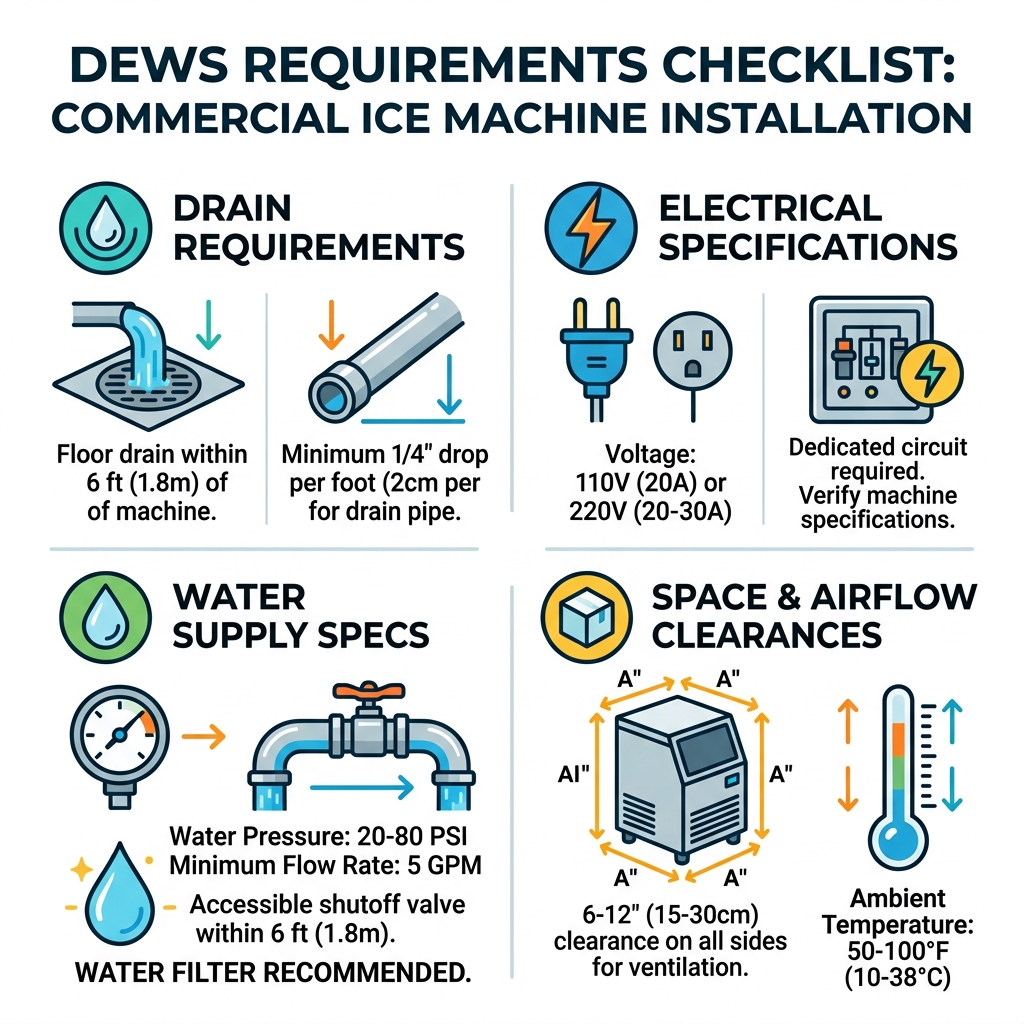
Pre-Installation: The DEWS Requirements for Ice Machine Installation
Before we even crack open the crate of a new unit, we have to talk about the "DEWS" framework. This is the industry-standard checklist for beverage equipment readiness. If any of these four pillars—Drain, Electricity, Water, or Space—are neglected, your ice machine installation is destined for trouble.
Electrical Specifications and Safety
Ice machines are high-draw appliances. They don't play well with others on the same circuit. We always insist on a dedicated circuit to prevent the breaker from tripping during the harvest cycle when the machine pulls the most power.
- 110V Units: Most undercounter and small cubers (producing under 300 lbs) require a 110-115V, 20-amp dedicated outlet.
- 220V Units: Large modular heads (producing 500 to 2,100 lbs) typically require a 220-240V, 20-30 amp dedicated 4-wire system.
- Safety First: In our service areas like Philadelphia and Atlantic City, local codes often require GFCI protection for outlets near water sources. Never use an extension cord; they are a fire hazard and a leading cause of voltage drops that fry expensive control boards.
Space, Ventilation, and Ambient Temperature
An ice machine is essentially a heat-rejection device. To make ice, it has to move heat out of the water and into the air. If the machine can't "breathe," it will overheat, work harder, and eventually fail.
We recommend a minimum of 6 to 12 inches of clearance on all sides, especially the rear and sides where the intake and exhaust vents are located. The ambient room temperature should stay between 50°F and 100°F. If you're in a hot kitchen in Cherry Hill or a humid basement in Newark, you might need even more clearance or supplemental cooling to keep production rates high.
Advanced Plumbing: Water Lines and Drainage Systems
Plumbing is where most DIY ice machine installation attempts go sideways. You aren't just connecting a garden hose; you're building a system that must handle constant pressure and gravity-fed waste.
| Feature | Gravity Drain | Pump Drain |
|---|---|---|
| Power Needed | No | Yes |
| Placement | Must be above floor drain | Can push water up/across |
| Maintenance | Low (keep clear of slime) | Moderate (check pump motor) |
| Best For | Kitchens with floor drains | Basements or bars without floor drains |
Water quality in the Northeast is notoriously tough. If your tap water is hard, mineral scale will build up on your evaporator plates like rust on an old bridge. This scale acts as an insulator, making it harder for the machine to freeze water and eventually causing the harvest cycle to fail. This is why we always recommend beverage equipment maintenance services that include regular descaling.
Connecting the Water Supply for Ice Machine Installation
The water supply line must be sized correctly to ensure the machine never "starves" for water.
- Sizing: Use a 3/8-inch OD line for machines producing less than 1,300 lbs, and a 1/2-inch line for anything larger.
- Pressure: You need between 20 and 80 PSI. If your pressure is too high, you'll need a regulator; too low, and the machine won't fill fast enough to keep up with its cycle.
- Shutoff: A dedicated shutoff valve must be within 6 feet of the unit for emergency access.
Proper Drainage and Air Gaps
Drainage is about more than just getting rid of meltwater. It’s a health department priority. You must maintain a 1/4-inch drop per foot for all horizontal drain runs. Most importantly, you must have a physical air gap between the end of the ice machine's drain pipe and the floor drain. This prevents "sewer gas" or actual sewage from backing up into your ice bin if the building's pipes clog.
Step-by-Step Setup and Initial Operation
Once the utilities are ready, the physical setup begins. We’ve seen units delivered on their side; if that happens, the machine must sit upright for at least 24 hours before being plugged in. This allows the refrigerant oil to settle back into the compressor.
- Leveling: This is the most underrated step. Use a spirit level on the top of the machine. If it's not level within 1/8 of an inch, the water won't flow evenly over the evaporator, leading to "hollow" cubes or ice slabs that won't drop.
- Connections: Connect your beverage equipment installation services lines. Use Teflon tape on threaded plumbing connections, but never on compression fittings.
- Flushing: Before connecting the final water line to the machine, flush it into a bucket for 2-3 minutes to clear out any construction debris or solder flux.
Final Testing and Startup After Ice Machine Installation
When you flip the switch to "ICE," the machine will usually run a self-check or a brief "wash" cycle. Watch the first few harvests closely.
- Harvest Timing: It should take about 15-30 minutes for the first batch.
- Bridge Thickness: Check the "bridge" (the thin strip of ice connecting the cubes). It should be about 1/8 to 3/16 of an inch thick.
- Leak Check: While the machine is running, check every fitting with a dry paper towel. Even a tiny "weep" can lead to a flood over time.
Initial Sanitization and Cleaning
Even a brand-new machine isn't "clean" by food-service standards. Dust from the factory and oils from the manufacturing process can linger.
- The First Batch: Always discard the first two full harvests of ice.
- Sanitize: Run a sanitization cycle using a nickel-safe cleaner. This protects the plating on your evaporator.
- Biofilm: In our humid Delaware and New Jersey service areas, "pink slime" (biofilm) can grow quickly. Starting with a sterile environment is the best way to delay its arrival.
Common Mistakes and Professional Considerations
We’ve seen it all—from machines tucked into closets with zero airflow to drains that run uphill.
- The "Shared Circuit" Trap: Plugging an ice machine into the same circuit as a refrigerator or a blender. When both compressors kick on, the breaker pops, and you arrive in the morning to a bin full of water.
- Leveling Errors: If the machine leans forward, the door won't seal, leading to "sweating" and mold.
- Skipping the Filter: In a hard-water region, skipping a filter can kill a machine in less than six months.
When to Hire a Professional
While small undercounter units can sometimes be a DIY project, modular heads and complex bar setups usually require a pro. Professional ice machine installation ensures:
- Code Compliance: We know the specific plumbing codes for Wilmington, Princeton, and Philadelphia.
- Warranty Protection: Many manufacturers will void your warranty if the machine wasn't installed by a certified technician.
- Reliability: We right-size the machine for your peak demand so you never run out of ice during a Saturday night rush.
Frequently Asked Questions about Ice Machine Installation
How long does a typical installation take?
For a standard setup where water, power, and drains are already in place, expect 2 to 4 hours. If we need to run new lines or perform minor carpentry to fit an undercounter unit, it can take a full day.
Do I really need a water filter for a new machine?
Yes. Absolutely. A filter doesn't just make the ice taste better; it protects the machine's internal components from sediment and scale. It's the cheapest insurance policy you can buy for your equipment.
Can I install a commercial ice machine outdoors?
Only if the model is specifically rated for outdoor use. Standard commercial machines are designed for indoor climates. Exposure to direct sunlight, rain, and extreme temperature swings will cause them to fail rapidly and will void your warranty.
Conclusion: Powering Your Perfect Pour
Your ice machine is the silent workhorse of your business. From chilling sodas to crafting cocktails, it is the foundation of your beverage program. Proper ice machine installation is the only way to ensure that workhorse doesn't turn into a liability.
At Carbonator Rental, we’ve been "Powering the Perfect Pour Since 1955." Whether you’re in Philadelphia, Newark, or Wilmington, our family-run team provides the local support you need. We don't just drop off a machine; we offer flexible rental options that include installation, maintenance, and emergency support. We also handle your CO2, nitrogen, and bag-in-box syrup deliveries, so your entire bar operation is streamlined under one reliable partner.
Don't leave your ice supply to chance. Contact Carbonator Rental for professional beverage equipment installation services today.
